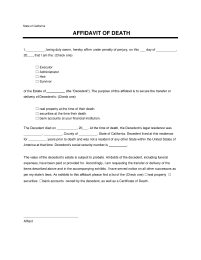
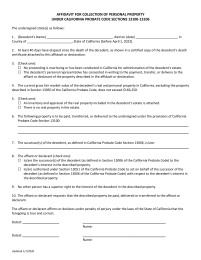
An affidavit is a statement indicating the content therein is true and can be used in legal proceedings. Affidavits are used in various scenarios such as verification of financial details, properties, business documents, death or birth verification, or as a witness.
Regardless of what type of affidavit one may need, there is some information that is always needed. It includes:
Name and address of the affiant
Age and birthday
Any other identifying information including work/occupation information
Location and date of the signing
True and concise statements should be written in the affidavit as false information attracts harsh repercussions. According to California law, the affidavits must be signed under oath. It can be executed by a notary or certified agents such as judges.
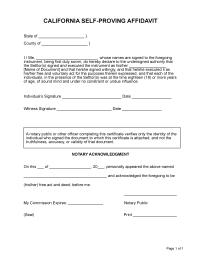
The California self-proving affidavit is a legal document containing a sworn statement and attached to the will. The Affidavit follows California laws section § 8220. It is signed by a witness and the notary public for the validity of the document.
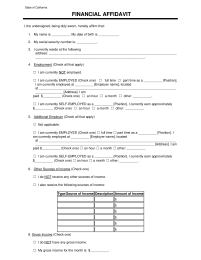
A California financial affidavit is a legal document that contains sworn information and statement regarding an affiant’s finances. The given information ranges from income, assets, debts, and expenses. The document is written according to California state laws and is used in court when dealing with child and spousal support.
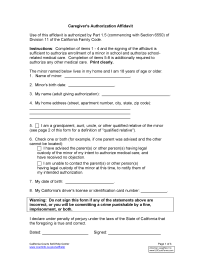
A California caregiver’s authorization affidavit is an official document that recognizes adults living with minors as their caregivers. The caregiver can use the form for education and health care purposes. It is written according to the California family code division 11. Minors [6500 – 7143] and PART 1.5. Caregivers section [6550 – 6552].
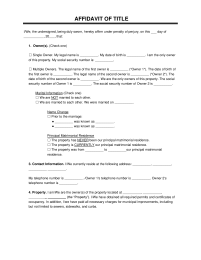
A California affidavit of title is a legally binding document written following California state laws. It is provided by a person who wants to sell property affirming the status of the property. The facts given in the affidavit of title are considered true when signed and notarized.
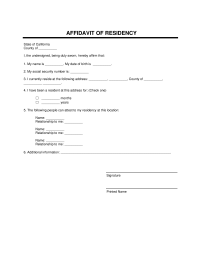
The California Affidavit of Residency is a legally binding document that shows where the affiant resides. It is used to prove the residency of the person and should be notarized to ensure the statement and information therein is true.
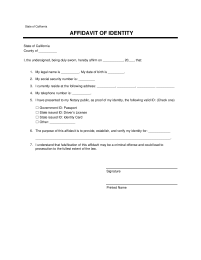
The California affidavit of identity is a legal document written following the California state laws. It acts as proof to show the true identity of a said person in a world where identity theft is very rampant. With such, in serious cases that require identification, word of mouth is not enough.
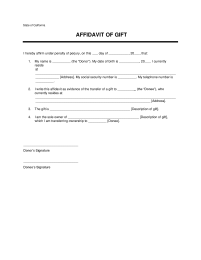
A California gift affidavit is a legally binding document that is used to confirm that a particular item was given to a person as a gift. The Affidavits of gifts are used when the gifted items are expensive and an ownership transfer is happening. Having legal proof makes the entire process seamless.
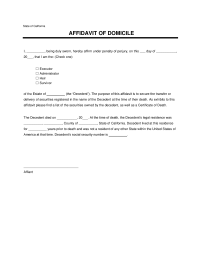
A California affidavit of domicile is a legally binding document used to verify details of the deceased. Such include the name and their place of residence when they died. It should be written following the California state laws for it to serve the purpose.
The California Affidavit for Collection of Personal Property is a legally binding document used by rightful heirs to an estate to request for transfer or delivery of the property to the successor.
The person who swears the affidavit is the one referred to as the affiant. They can also be referred to as the deponent.
Who can make an affidavit and for what purpose?
An affidavit can be made by a witness, an expert in a relevant case, an applicant or plaintiff or a respondent/defendant. The affidavits are made to verify business documents, birth, and death, financial details, for witnesses in a case among other things.
Do affidavits in California need notarization?
Yes. All affidavits in California require to be sworn under the oath. They are executed by notary public or certified agents such as judges for confirmation of the veracity of the stated information.
Are affidavits used in courts only?
The sworn statements are used in court proceedings or negotiations. Mostly, they are used in bankruptcy cases and family law. Where need be, they are used in criminal and civil cases.
Can an affidavit be considered a legally binding?
Yes. The affidavit is created by a person of sound mind who signs the legal document by themselves and is sworn under the oath before a judge or by the notary public.
Is an affidavit same as a declaration?
No. An affidavit is a sworn statement that confirms the statements are true under the oath. Declarations are written statements which the author believes to be true but are not sworn before a notary public or a judge.
Does an affidavit need to be witnessed?
Yes. The witness in the affidavit is the person who authorizes the statements to affirm that the sworn statements are true. In this case, it is either the notary public or authorized agents such as judges.
Can an affidavit be used as evidence?
An affidavit can be used as evidence if it is testified. It cannot be used for evidence if there are objections because hearsay is not admissible as an evidence.
Can an affidavit taken outside California be used in California?
Yes. However, the affidavit should have been taken in any other state of the United States. It should also be taken before a commissioner appointed by the governor of California State.
Are affidavits taken in foreign countries used in California?
An affidavit taken in a foreign country for use in California requires to be taken either before a consular agent of the United States, minister, ambassador, judge of a court of record having a seal in the foreign country, consul, or a vice-consul.
We use cookies on our website to give you the most relevant experience by remembering your preferences and repeat visits. By clicking “Accept”, you consent to the use of ALL the cookies.
This website uses cookies to improve your experience while you navigate through the website. Out of these, the cookies that are categorized as necessary are stored on your browser as they are essential for the working of basic functionalities of the website. We also use third-party cookies that help us analyze and understand how you use this website. These cookies will be stored in your browser only with your consent. You also have the option to opt-out of these cookies. But opting out of some of these cookies may affect your browsing experience.
Necessary cookies are absolutely essential for the website to function properly. These cookies ensure basic functionalities and security features of the website, anonymously.
Cookie
Duration
Description
cookielawinfo-checkbox-analytics
11 months
This cookie is set by GDPR Cookie Consent plugin. The cookie is used to store the user consent for the cookies in the category "Analytics".
cookielawinfo-checkbox-functional
11 months
The cookie is set by GDPR cookie consent to record the user consent for the cookies in the category "Functional".
cookielawinfo-checkbox-necessary
11 months
This cookie is set by GDPR Cookie Consent plugin. The cookies is used to store the user consent for the cookies in the category "Necessary".
cookielawinfo-checkbox-others
11 months
This cookie is set by GDPR Cookie Consent plugin. The cookie is used to store the user consent for the cookies in the category "Other.
cookielawinfo-checkbox-performance
11 months
This cookie is set by GDPR Cookie Consent plugin. The cookie is used to store the user consent for the cookies in the category "Performance".
viewed_cookie_policy
11 months
The cookie is set by the GDPR Cookie Consent plugin and is used to store whether or not user has consented to the use of cookies. It does not store any personal data.
Functional cookies help to perform certain functionalities like sharing the content of the website on social media platforms, collect feedbacks, and other third-party features.
Performance cookies are used to understand and analyze the key performance indexes of the website which helps in delivering a better user experience for the visitors.
Analytical cookies are used to understand how visitors interact with the website. These cookies help provide information on metrics the number of visitors, bounce rate, traffic source, etc.
Advertisement cookies are used to provide visitors with relevant ads and marketing campaigns. These cookies track visitors across websites and collect information to provide customized ads.